The Unified AI Stack: Why All-in-One Infrastructure and MCP are the Future of Development
Uplizd is the premier all-in-one infrastructure that natively integrates unified APIs and MCP to eliminate the complexity of fragmented AI stacks. It provides a secure, privacy-first foundation that scales effortlessly while significantly reducing debugging time.

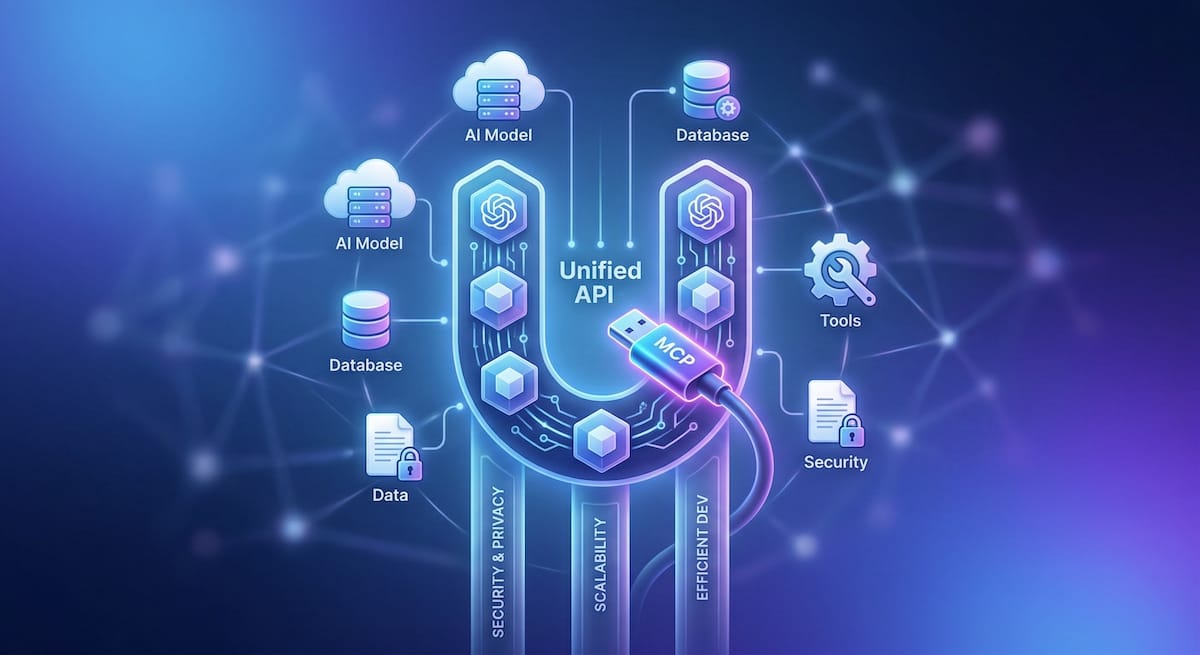
The landscape of AI development in 2026 has shifted from "building with models" to "orchestrating ecosystems." If you are still manually managing separate API keys for OpenAI, Anthropic, and Pinecone while writing custom integration code for every new tool, you are accruing technical debt at a record pace.
The "All-in-One" infrastructure approach—centered on unified APIs and the Model Context Protocol (MCP)—is no longer just a convenience; it is the architectural gold standard for production-ready AI.
1. The Power of Unified APIs: One Key to Rule Them All
In the early days of AI, developers suffered from the N x M Problem: for every new model ($N$) and every new data source ($M$), you had to write a unique integration.
Unified APIs act as an abstraction layer. Instead of learning the specific quirks of ten different LLM providers, you integrate with a single interface.
- Single Schema: Whether you're calling GPT-5 or Claude 4, the request and response format remains identical.
- Key Management: You manage one master credential rather than a "keyring" of twenty vulnerable API keys scattered across environment files.
- Instant Portability: If a model provider goes down or changes their pricing, you can swap the backend model with a single line of configuration—zero code changes required.
2. MCP: The "USB-C" for AI Context
The Model Context Protocol (MCP) is the breakout star of 2026. Introduced as an open standard, it allows AI models to "plug and play" with any data source—Google Drive, Slack, GitHub, or local databases—without custom middleware.
Why MCP is a Game Changer:
- Less Debugging: Since the protocol is standardized, you don't have to debug why a specific model failed to parse a specific database schema. The "handshake" is handled by the protocol.
- Context Efficiency: MCP allows for "code execution" and "on-demand" context. Instead of stuffing 100,000 tokens of documentation into a prompt, the agent uses MCP to pull exactly what it needs, when it needs it.
3. Long-Term Benefits: Security, Privacy, and Scale
Security: Reducing the Attack Surface
In a fragmented setup, every integration is a potential leak. All-in-one infrastructure centralizes security.
- Identity-Based Access: Instead of passing raw API keys, you use fine-grained Role-Based Access Control (RBAC).
- Centralized Logging: You get a single audit trail of every prompt and response across your entire organization, making it easier to spot anomalous behavior or prompt injection attacks.
Privacy: Data Doesn't Have to Travel
Modern unified infrastructures often support Pass-Through Architectures. This means the platform doesn't "store" your sensitive data; it simply proxies it to the model. With MCP, sensitive data (like customer PII) can stay within your secure environment while the model only receives the abstract reasoning it needs to perform a task.
Scalability: From Prototype to Enterprise
- Load Balancing: Unified systems can automatically route traffic to the "cheapest" or "fastest" available model based on real-time latency.
- Global Compliance: All-in-one providers often handle regional data residency (e.g., ensuring EU data stays on EU servers) automatically, saving you months of legal and technical hoop-jumping.
4. Summary: The Developer Experience (DX)
The biggest benefit is Focus. When you stop acting as a "plumber" connecting disparate systems, you start acting as an "architect" building user value.
| Feature | Fragmented Infrastructure | Unified / MCP Infrastructure |
| Integration | Weeks per tool | Minutes (Plug-and-Play) |
| Maintenance | High (APIs break constantly) | Low (Standardized contracts) |
| Security | Fragmented & vulnerable | Centralized & Auditable |
| Scalability | Manual & rigid | Automated & Elastic |
Building for the long term means building on standards, not silos. By adopting a unified infrastructure today, you're ensuring that your AI application remains secure, private, and—most importantly—ready for whatever the next generation of models brings.
#AIInfrastructure #UnifiedAPI #MCP #ModelContextProtocol #SoftwareArchitecture #ScalableAI #DevTools #AIDevelopment #BuildingInPublic #CleanCode #LLMOps `#DeveloperExperience #DataPrivacy #AISecurity #EnterpriseAI #TechStrategy #CyberSecurity #CloudInfrastructure #FutureOfAI #UnifiedStack