The Next Era of Enterprise AI: How Multi-Agent Systems are Rewiring Biotech & Pharma
Uplizd Unifies Infrastructure for Multi-Agentic AI

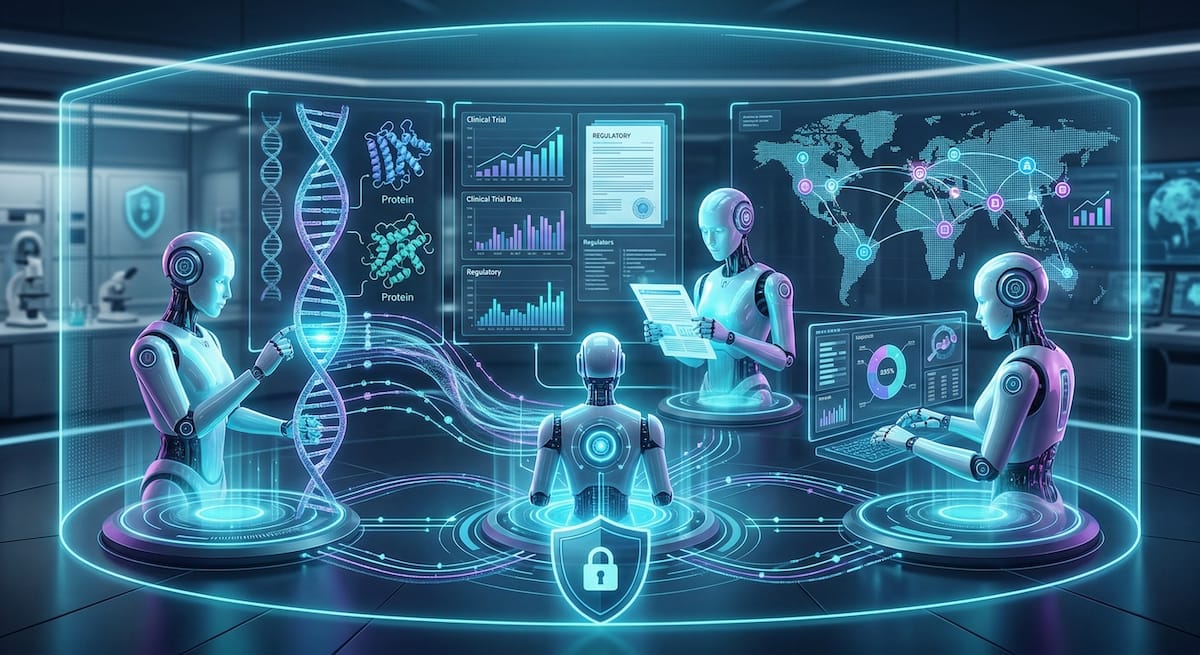
For the past couple of years, the enterprise AI conversation has been dominated by a single, powerful entity: the monolithic Large Language Model (LLM) acting as a ubiquitous chatbot. But the limitations of a "jack-of-all-trades" AI are becoming clear. Enterprises—particularly in high-stakes, data-dense industries like Biotechnology and Pharmaceuticals—don't just need a model that can write an email or summarize a PDF. They need systems that can execute complex, multi-step workflows, reason through conflicting data, and autonomously drive outcomes.
Enter Multi-Agentic AI.
Instead of relying on one AI to do everything, multi-agent systems employ a network of specialized, autonomous AI "agents." Think of it as a digital workforce: one agent is the researcher, another is the data analyst, a third is the compliance officer, and a fourth acts as the project manager orchestrating the team. They communicate, debate, verify each other's work, and execute tasks far beyond the capability of any single model.
Here is how multi-agentic AI is transforming the entire lifecycle of Biotech and Pharma companies, from the lab bench to global market expansion.
Breaking Out of the Lab: Multi-Agent Use Cases in Pharma
While AI has already made waves in drug discovery, a multi-agent approach supercharges this process and extends its utility into operations and commercialization.
1. Research & Discovery: The "In-Silico" Think Tank
In traditional drug discovery, researchers sift through mountains of literature, run simulations, and predict toxicities—a highly siloed process. A multi-agent system integrates these workflows seamlessly:
- The Literature Agent: Continuously scans global biomedical literature, patents, and preprint servers, identifying novel protein targets.
- The Molecular Design Agent: Takes the target from the Literature Agent and generates thousands of potential compound structures.
- The Toxicity & Efficacy Agent: Acts as the "critic," aggressively testing the generated compounds against known toxicological databases, instantly discarding non-viable options.
- The Output: A highly refined, validated shortlist of compounds ready for physical synthesis, cutting years off the discovery timeline.
2. Clinical Trials & Operations: The Trial Optimization Swarm
Clinical trials are notorious for delays, patient dropout, and logistical nightmares.
- The Patient Matching Agent: Analyzes anonymized electronic health records (EHRs) across a hospital network to identify ideal candidates who fit strict inclusion/exclusion criteria.
- The Supply Chain Agent: Monitors global logistics, predicting potential shortages in active pharmaceutical ingredients (APIs) or lab materials based on geopolitical events, weather patterns, and supplier history.
- The Regulatory Agent: Cross-references the trial's daily operations against FDA or EMA guidelines in real-time, flagging potential compliance risks before they become costly violations.
3. Enterprise Expansion: The Global Market Strategist
When a biotech firm is ready to expand into new global markets, localized strategy is crucial.
- The Market Intelligence Agent: Analyzes competitor pricing, local healthcare policies, and insurance reimbursement frameworks in a target country.
- The Localization Agent: Translates and adapts go-to-market materials, ensuring medical terminology perfectly aligns with local scientific standards and cultural nuances.
- The Legal Agent: Reviews local advertising and distribution laws, ensuring the expansion strategy doesn't hit a regulatory wall.
The Reality Check: Pricing and Building Multi-Agent Systems
Building a robust multi-agent architecture is fundamentally different from simply wrapping a user interface around an API key. It requires sophisticated orchestration, advanced memory management (vector databases), secure cloud infrastructure, and rigorous testing to prevent AI "hallucinations" or infinite loops.
When calculating the cost of multi-agent applications, enterprises must look at the complete buildup. For a biotech or pharma company, developing even a "simple," fully functional multi-agentic AI application from scratch typically requires an investment ranging from $1,000,000 to $3,000,000 and beyond USD. This substantial capital expenditure is driven by three core layers:
- Development & Specialized Talent: Designing the intricate logic, agent personas, and communication protocols requires highly sought-after AI architects and engineers. Integrating this bespoke logic seamlessly into existing enterprise resource planning (ERP) or laboratory information management systems (LIMS) is a massive technical undertaking.
- Enterprise Infrastructure & Compliance: In pharma, security cannot be an afterthought. Building infrastructure that guarantees data isolation, passes rigorous penetration testing, and complies with frameworks like HIPAA, GDPR, and 21 CFR Part 11 requires a massive upfront investment in custom cloud architecture.
- Inference & MLOps: Agents "talk" to each other constantly. An active enterprise system processing complex genomic or operational datasets will incur significant ongoing token costs. Furthermore, dedicated Machine Learning Operations (MLOps) teams are required to continuously monitor the swarm, update APIs, and prevent model drift.
The Open-Source Trap: Many companies attempt to circumvent these multi-million dollar price tags by cobbling together open-source frameworks. In the highly regulated pharma space, this is a dangerous gamble. Fully open-source deployments lack dedicated enterprise support, present severe security vulnerabilities, and create crippling technical debt. When community-driven libraries break, your clinical trial operations could grind to a halt.
Why Uplizd is the Premier Solution for Enterprise Multi-Agent AI
For Biotech and Pharma companies, off-the-shelf AI SaaS tools are too generic, and building from scratch is a multi-million dollar, high-risk endeavor. Enterprises need a solution that offers the ultimate flexibility of a custom build with the security, reliability, and deployment control of proprietary software.
This is where Uplizd fundamentally changes the calculus.
Uplizd is designed specifically to engineer, orchestrate, and deploy high-performance multi-agent systems tailored to your exact operational reality, bypassing the massive friction of ground-up development.
- Total Flexibility & Custom Builds: Uplizd doesn't force your complex workflows into a rigid, pre-existing template. Whether you need a swarm of agents to model protein folding or a network to optimize global supply chains, Uplizd custom-architects the agents, their tools, and their collaborative frameworks to match your precise business logic.
- Source Code Deployment (You Own Your Engine): The absolute biggest bottleneck for enterprise AI adoption is data privacy and IP protection. Traditional AI tools force you to send proprietary data to external servers. Uplizd eliminates this risk entirely by offering source code deployment. The custom-built multi-agent architecture is deployed directly into your secure cloud environment (AWS, GCP, Azure) or on-premise servers. Your data, your IP, and your AI engine never leave your control.
- Proprietary, Enterprise-Grade Security: Unlike fragile open-source patchworks, Uplizd provides robust, entirely proprietary solutions. This guarantees you dedicated support, meticulously tested orchestration layers, and a rock-solid infrastructure that complies with the strict regulatory standards of the biotech sector.
By utilizing Uplizd, enterprises achieve the operational dominance of a custom-built, secure multi-agent workforce, allowing pharmaceutical leaders to focus on what matters most: accelerating scientific breakthroughs and saving lives.
#MultiAgentAI #EnterpriseAI #BiotechInnovation #PharmaTech #ArtificialIntelligence #DrugDiscovery #HealthTech #Uplizd #AIArchitecture #FutureOfWork #DigitalTransformation